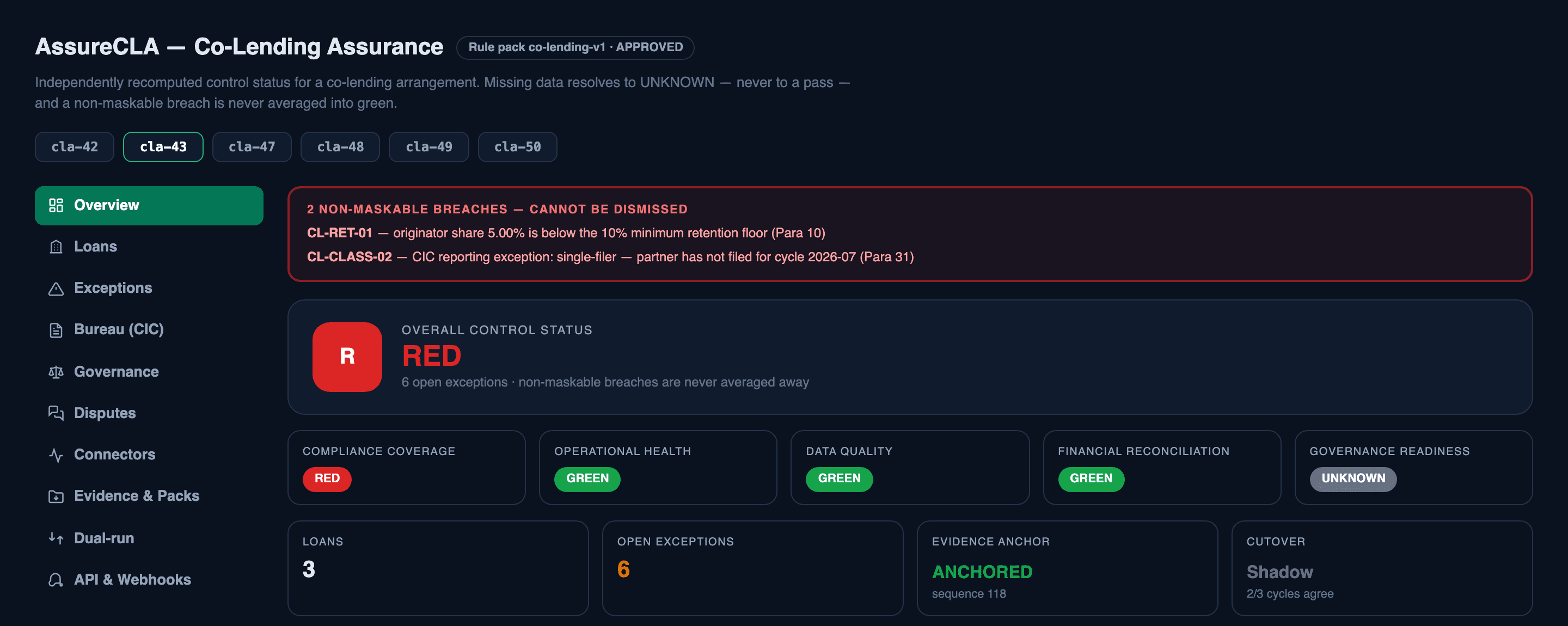
From 1 January 2026, every new co-lending arrangement in India operates under the RBI (Co-Lending Arrangements) Directions, 2025: each regulated entity retains at least 10% of every loan, the partner commits irrevocably before disbursement and books its share within 15 calendar days, all money routes through escrow, both lenders report to the credit bureaus, and borrower-level classification must move in step by the end of the next working day.
Each obligation is simple to state. Proving all of them held, continuously, across two independent systems of record — that is the problem nobody in the transaction flow is positioned to solve.
Two books, one set of obligations
The originating NBFC keeps one book. The partner bank keeps another. An orchestration platform moves data between them — faster every year — but speed is not the issue. The issue is semantic disagreement: different loan identifiers, different day-count and holiday rules, different allocation waterfalls, different DPD clocks. Most days the two books agree. The days they don't are the days that matter at inspection — and a spreadsheet reconciliation three weeks later finds them after the window to fix them has closed.
What AssureCLA does
AssureCLA sits beside both lenders and independently recomputes what each side claims. Twenty-four controls, each citing the regulatory paragraph it enforces, run continuously against evidence each party files for itself:
- The four-point booking test. "Booked within 15 days" means four events — disbursement, partner acceptance, cash reimbursement, and the partner's core-ledger GL posting — each inside the window. A middleware acknowledgement is not a booking; the GL posting that slid to day 17 through a weekend batch is exactly what this control catches.
- Escrow statement continuity. We read the statements your escrow bank already produces — MT940/942, MT900/910 advices, camt.052/053/054 — and prove the series is complete: sequence numbers gap-free, closing balances chaining into the next opening. A gap is affirmative evidence of unseen money movements, and reconciliation over a hole must not read green.
- Both-lenders bureau assurance. Each RE files its own share to the credit bureaus. Single filers, divergent DPD, contradictory statuses and unacknowledged files are caught per cycle — while the cycle is still open.
- Canonical credit identity. One loan, two systems, different IDs. Deterministic matching first, conservative fuzzy matching with recorded reason and confidence second, an attributed human queue for everything ambiguous — and a loan visible in only one book becomes a provable finding, not a footnote.
Unassessed is never healthy
The design principle underneath everything: missing evidence resolves to UNKNOWN — rendered grey, never silently promoted to a pass. A regulatory breach is non-maskable: it forces the arrangement RED no matter how many other controls pass, surfaces on every screen, and can be remediated through an attributed lifecycle — but never dismissed. Every result can be reproduced from the same events and the same versioned rule pack, years later, under a manifest hash.
A TSP with no allegiances
AssureCLA is a Technology Service Provider — not a LOS, not an LMS, not the orchestration platform executing the deal. It never touches funds (settlement messages are advice-only, and a CI architecture test fails our own build if money-movement capability appears in the source), never makes the credit decision, and is engaged by the arrangement rather than either side. Flat pricing, never a share of the transaction — neutrality is the product.
Where this goes next
The same evidence identity extends into AssurePool: eligibility and holding-period screens over the arrangement's evidence base, a frozen loan tape under a manifest hash, and post-close surveillance — waterfall conservation checked to the last minor unit. Pool assurance, not pool brokerage: the transferee's diligence stays its own.
If you run a co-lending book — or are about to — the first step is a delta report on one live programme and one completed period. Book a working session or read the product page at /products/assurecla.