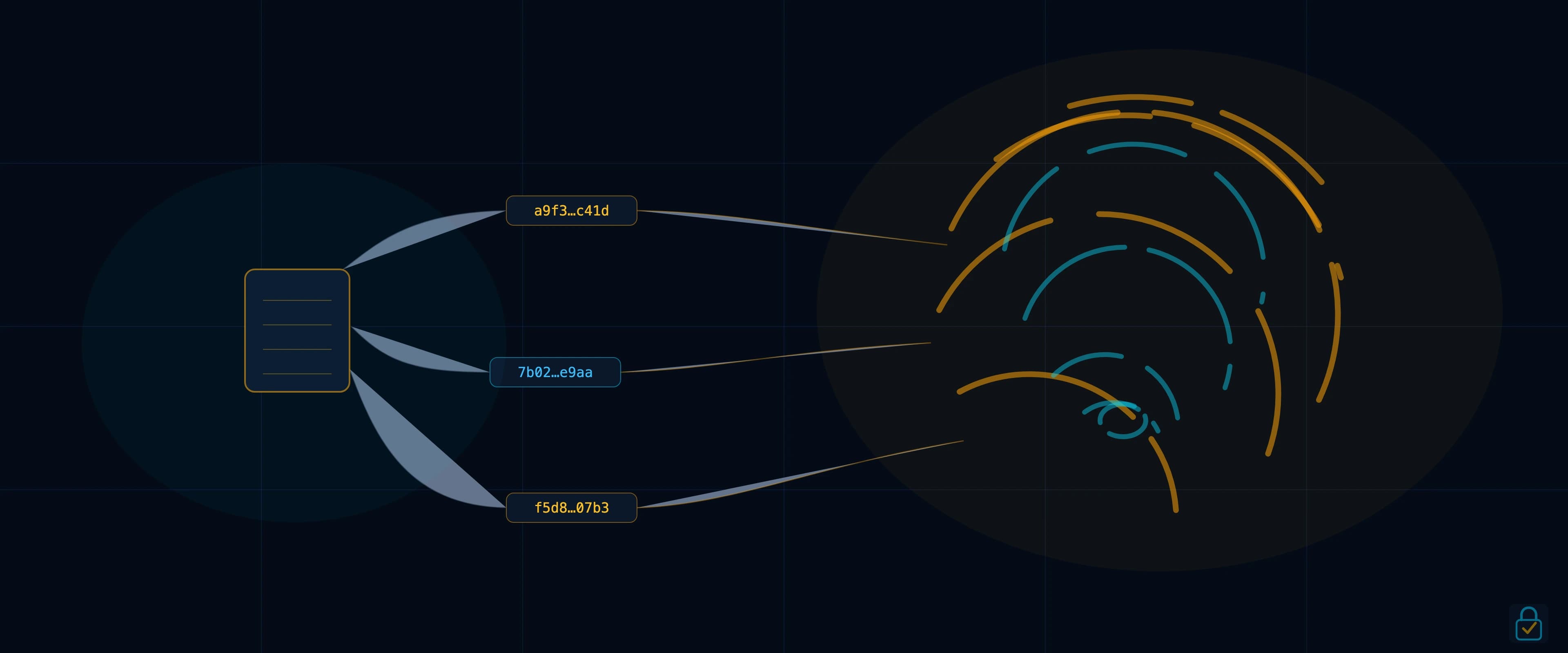
A bank in Mumbai finances a receivable on a Tuesday. An NBFC in Chennai finances the same invoice — same borrower, same buyer, same underlying trade — on the Thursday that follows. Neither institution broke a rule. Neither analyst missed something they should have caught. They simply had no way of knowing about each other.
That sentence is worth sitting with, because it reframes a problem the industry keeps describing as a fraud problem into what it actually is: a coordination problem. Fraud implies intent — a borrower deliberately deceiving a lender. Coordination failure implies something more mundane and more fixable: two counterparties acting in good faith, inside a market with no shared memory.
Why "just check the bureau" doesn't solve it
The instinctive answer is that credit bureaus already exist for exactly this. They don't, not for this specific failure mode. A bureau tells a lender what a borrower has borrowed — aggregate facility exposure, repayment history, delinquency. It does not tell a lender whether this specific receivable — this invoice number, this purchase order, this shipment — has already been pledged, discounted or financed somewhere else. Financing a receivable and drawing a credit facility are related but distinct events, and the instrument-level question sits in a gap the bureau architecture was never built to answer.
On-exchange, the gap partially closes. A receivable financed through TReDS is visible to other participants on that exchange — which is precisely why TReDS financed roughly ₹2 lakh crore of MSME receivables in FY25, against India's addressable MSME credit gap of ₹20–25 lakh crore (RBI Expert Committee, 2019) — under a tenth of it. The overwhelming majority of receivable financing in India happens off any exchange at all: bilateral arrangements between a lender and a borrower, invisible to every other lender by construction. A receivable financed off-exchange with one NBFC and pledged bilaterally to a bank a week later is invisible to both rails, because neither rail was ever designed to see outside itself.
The market is entering this problem, not leaving it
If this were a shrinking niche, it would matter less. It isn't. India's factoring penetration sits at roughly 1% of GDP — around ₹3.4 lakh crore in 2024 — against a European Union benchmark near 11% of GDP (Factors Chain International; EU Federation, 2024). That gap is not a forecast, it's a published cross-market comparison, and closing even a fraction of it means materially more receivable-financing volume moving through exactly the bilateral, off-exchange channels where duplicate financing is structurally invisible. NBFC co-lending AUM alone stood at roughly ₹1.1 lakh crore as of 31 March 2025 (CRISIL) — a base that grows every quarter a new co-lending arrangement is signed, and every arrangement is another lender relationship a borrower could, in principle, present the same receivable to twice.
Regulatory attention is already moving in this direction from an adjacent angle. Supervisory scrutiny reported in late 2024 flagged that some NBFCs were misclassifying supply-chain-finance exposure as revolving credit rather than the discrete, self-liquidating facilities they actually are — a finding that, structurally, depends on exactly the kind of instrument-level traceability that catching duplicate financing also requires. A regulator asking "can you prove this facility maps to one specific, unique trade" and a lender asking "has this specific receivable already been financed elsewhere" are, underneath, the same question asked from two different desks.
What actually closes the gap — and what doesn't
The naive fix is a shared database. It doesn't survive contact with the market's actual structure, because no single lender, exchange or platform is in a position to be the party every other lender trusts with a complete view of their book. A shared database run by any one participant is a competitive-intelligence risk to everyone who isn't that participant, which is exactly why one was never built.
What actually closes the gap is a neutral fingerprint registry — not a database of receivables, a database of tamper-evident hashes of receivables, held by a party that is not itself a lender, a marketplace, or a participant in any transaction it touches. A lender checks a receivable's fingerprint before financing it. If the fingerprint already exists — registered by another lender, on another rail, in another city — the check returns a band (a coverage count, a value range, never the other lender's identity, never the raw invoice) and the two institutions have grounds for a conversation that, until that moment, neither had any way to know they needed to have. If the fingerprint doesn't exist, the lender registers it and moves on. No lender exposes its book. No exchange has to trust another exchange. The registry only ever answers one question, and it answers it the same way for everyone who asks.
Why this has to be something an agent can ask, not just a person
Here is the part that changes the economics: this check is cheap enough to run on every receivable only if it costs nothing meaningful — in money, in latency, in analyst time — to check. A human underwriter manually querying a portal for every invoice in a receivables book does not scale past a handful of large-ticket deals a week. An AI agent triaging a queue of forty small-ticket receivables before they ever reach a human analyst's desk is a completely different economic proposition — and it's the one that actually gets duplicate-financing checks run on the volume of deals where they're needed most, which is precisely the small-ticket, high-frequency end of the market that manual review has never been able to reach.
That's why this check is one of the first things exposed over MCP: a lender's own AI agent can call the same duplicate-financing registry a human analyst already trusts, under a key that only ever narrows what the agent can see, returning the same band-only, no-identity-exposed answer a human gets — before the receivable ever reaches a queue. The agent doesn't decide anything. It surfaces a fact fast enough that a fact-check stops being something a busy desk skips under volume pressure.
The honest caveat: how much duplicate financing actually happens today, undetected, off-exchange, is not a number anyone can cite with a straight face — it is, definitionally, the thing nobody currently has visibility into. That absence of a number is itself the argument. A market growing toward European penetration levels, adding co-lending arrangements every quarter, running the overwhelming majority of its volume off any exchange, cannot simultaneously claim the coordination problem doesn't exist just because nobody has measured it yet.
See the duplicate-financing check run live, or read how the registry works end to end.