What TReDS does, and does well
The Trade Receivables Discounting System (TReDS) is an RBI-regulated electronic platform where MSME suppliers get their acceptedinvoices on approved corporate/government buyers discounted by competing financiers. Its strengths are real: the buyer’s acceptance de-risks the receivable, competitive bidding compresses cost, and the exchange standardises the process. For a supplier whose buyer is onboarded and who has an accepted invoice, it is an excellent rail.
What it does not reach
By design, TReDS operates after acceptance, on the exchange, with onboarded buyers. That leaves a large space outside it:
Pre-shipment. Finance needed to fulfila purchase order — before any invoice exists, let alone an accepted one — is outside the post-acceptance model entirely. The supplier’s cash crunch is typically at input-procurement stage, weeks before dispatch; TReDS begins only once goods have shipped and the buyer has accepted.
Off-exchange & bilateral.Receivables where the buyer isn’t onboarded, or the lender wants to finance on its own book bilaterally, never reach the exchange. Onboarding a buyer onto TReDS is itself a gated process — many mid-market and unlisted buyers, and most overseas buyers, are simply not on any platform.
Messier evidence.Unaccepted invoices, services or semi-finished goods, longer durations, and deals needing deeper diligence than acceptance alone don’t fit the standardised flow.
Side by side
The two rails answer different questions. TReDS answers “how cheaply can an acceptedinvoice on an onboarded buyer be discounted?” Off-exchange factoring answers “can this specific, messierreceivable be financed at all?” The table below maps where each lands.
| Dimension | TReDS (regulated exchange) | Off-exchange / bilateral factoring |
|---|---|---|
| Buyer requirement | Buyer must be onboarded and must accept the invoice | No onboarding needed; works with any buyer, including unlisted or overseas |
| Onboarding | Supplier, buyer and financiers each enrol on the platform | Bilateral — only the lender and its borrower; no third-party enrolment |
| Stage financed | Post-shipment, post-acceptance only | Pre-shipment through post-shipment — including unaccepted invoices |
| Pre-shipment coverage | None — no invoice exists yet | Yes — PO-stage funding is squarely in scope |
| Duplicate-financing dedup scope | Strong within the platform: an invoice financed on one TReDS exchange is visible to that exchange | Lender sees only its own book; the same receivable can be pledged elsewhere unseen |
| Pricing mechanism | Competitive bidding compresses the discount rate | Lender prices bilaterally against its own diligence and cost of capital |
| Who it reaches | Suppliers to large, creditworthy, onboarded anchors | Thin-file, regional and mid-market MSMEs the exchange doesn’t serve |
The off-exchange problem
Off-exchange, no central facility has vetted the buyer, confirmed the goods moved, or checked whether the receivable is already financed. The lender carries all of that diligence itself — and doing it manually on a smaller MSME is often un-economic, which is precisely why these deals get declined. The risk isn’t unmanageable; the cost of establishing it is.
The dedup blind spot
The most consequential gap is duplicate financing. Because a TReDS exchange sees every invoice transacted on it, the same invoice cannot be discounted twice on that exchange. That guarantee is real — but it stops at the platform boundary. It does not extend to a second TReDS exchange, to a bank’s own bilateral book, or to a private financier down the road. A supplier can therefore present the same underlying receivable off-exchange to a lender who has no way of seeing that it is already pledged. The invoice is genuine; the double-pledge is the fraud.
What an evidence layer adds
This is where a Verified Receivables Pack fits: invoice authenticity (e-invoice IRN), goods movement (e-way), buyer establishment, a lender-side CERSAI / Account-Aggregator conflict check, and a related-party screen — each labelled by evidence tier, distilled into an Evidence Confidence Score with a conflict engine. It makes the off-exchange receivable assessable at a cost that fits the margin, while every signal stays exactly that: a signal. The lender sets the advance and makes the call.
Each signal answers a distinct question the off-exchange lender would otherwise chase by hand. The IRN check confirms the invoice was actually reported to the GST system rather than typed up for the loan. The e-way record indicates the goods moved. The buyer-establishment check tests that the counterparty exists and trades. The related-party screen flags a buyer and supplier that are, in substance, the same interest — a common shape for a fabricated receivable. None of these decide the deal; together they let a credit team reach a view in the time the margin can bear.
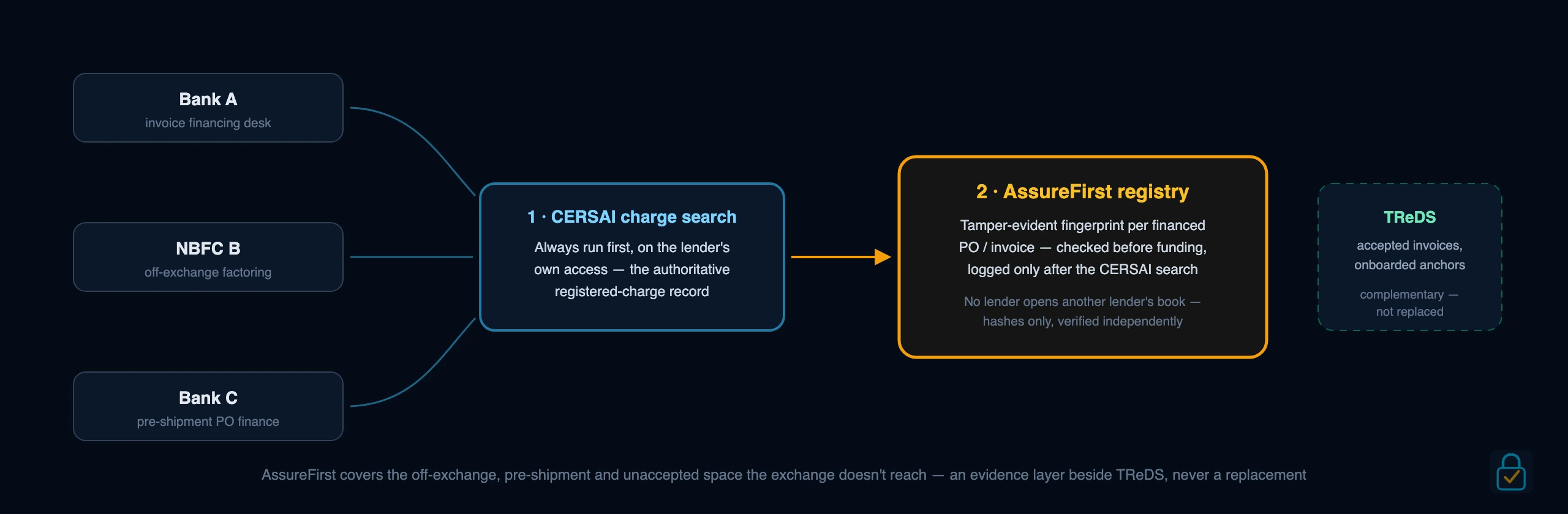
The one question a single lender genuinely cannot answer from its own book is whether the receivable is already financed somewhere else. A CERSAI charge search helps where a charge has been registered, but much bilateral factoring never files one. Closing that blind spot needs shared visibility acrossfinanciers, not deeper diligence within one.
Complementary, not competitive
AssureLocker is a Technology Service Provider: it is not an exchange, not a lender, and not a substitute for TReDS. It holds no funds, sets no advance, and makes no credit decision — it surfaces evidence and signals, and the lender always makes the call. A supplier with an accepted invoice on an onboarded buyer should use TReDS. Our wedge is the pre-shipment, off-exchange and unaccepted space the exchange doesn’t reach — and a TReDS operator is a partner conversation, not a rival. We focus on deals from ₹30 lakh — aggregated across one or more POs — where the deeper evidence is worth assembling.
Where this lands in the product
On the single-deal side, AssureSignal for Invoice Factoringassembles the Verified Receivables Pack for an off-exchange receivable — the authenticity, goods-movement, buyer-establishment and related-party signals above, tiered by evidence strength and distilled into an Evidence Confidence Score. It is decision support for the lender’s own underwriting, not a decision.
For the cross-financier dedup gap — the one blind spot a single lender cannot close alone — AssureFirst is a shared first-financing registry taking shape with design partners, so participating lenders can flag when the same receivable is being pledged in more than one place. It is forming, not a live or universal registry, and participating lenders verify independently; it is not a guarantee that a receivable is unencumbered. Used together, the pack sharpens the single-deal view and the registry begins to extend visibility past the platform boundary the diagram above marks — with the credit decision resting, always, with the lender.