
Lender
Receive a source-linked entity and signatory evidence pack with freshness and consent scope visible at review time.
The lender retains onboarding policy, reliance checks and every approve or reject decision.
See the lender flow →Verify once at the source; reuse it across participating workflows on the holder’s consent, under each relying party’s policy. One assurance layer for both sides of every programme — the entity (DigiKYB) and the individual who signs for it (DigiKYC) — registry-backed, lifecycle-monitored and consent-gated.
Built like digital public infrastructure: authoritative sources, holder consent on every disclosure, verifiable records a programme can check without calling us. We carry evidence; we never decide for the relying party.
Identity lifecycle
AssureVerifID carries evidence between parties without taking over the holder's consent or the relying party's policy decision.
Check the permitted identity claim against its authoritative registry, issuer or partner-mediated rail.
Package the verified claims with provenance, freshness and explicit unresolved fields.
The entity or individual approves the disclosure scope for the intended relying workflow.
Present consented proof that the recipient can verify and assess under its own policy.
Re-check supported source states and surface material change or expiry without silently rewriting history.
Choose your perspective
Receive a source-linked entity and signatory evidence pack with freshness and consent scope visible at review time.
The lender retains onboarding policy, reliance checks and every approve or reject decision.
See the lender flow →Reuse verified claims across participating programmes without turning every integration into another document-collection silo.
Presentation is consent-gated and subject to each programme's permitted sources and policy.
See the platform flow →Build DigiKYB or DigiKYC once, control what is disclosed, and reuse proof with participating recipients.
Reuse never removes recipient diligence and does not imply universal acceptance by every institution.
Explore holder identity →The layer
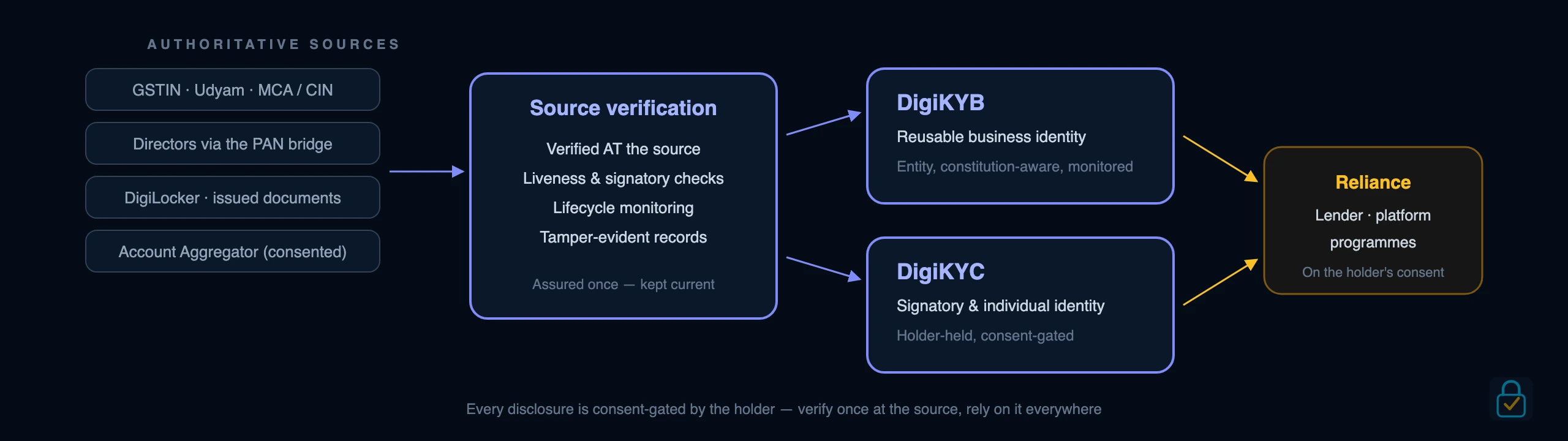
Identity claims are verified against the registries that own them, held by the holder, and shared only on consent — so a programme inherits assurance instead of repeating collection.
Inside the suite
Reusable, registry-backed business identity — constitution-aware, directors resolved via the PAN bridge, lifecycle-monitored — built once and relied on across programmes on the business’s consent.
Explore DigiKYB →Signatory and individual identity, source-verified through official document rails with liveness checks — held by the person and disclosed on their consent, scope always the holder’s choice.
Explore DigiKYC →Why an assurance layer
Every identity claim traces to the authoritative registry or issuer that minted it — never a self-declared field. What cannot be source-verified is labelled, not smoothed over.
The holder approves every disclosure and chooses how much to share — full, limited or custom — with the consent on record.
Registrations lapse, directors change, documents expire — the layer keeps watching and flags material change to the holder and relying programmes.
One verification serves many programmes — the reliance travels while the underlying evidence stays with the holder.
From the Learn library
What is DigiKYB? Verifiable Business Identity in India
Reusable KYB: Verify a Business Once, Reuse Across Participating Lending Workflows
What is DigiKYC?
Verifiable Credentials in India
DPDP Act & KYC Compliance
Aadhaar-Anchored DID in India
Operating boundary
A 30-minute walkthrough of the identity layer — how DigiKYB and DigiKYC verify at the source, and how a programme relies on them without owning the collection burden.